
On-demand Video
The Future of Search & Discovery: Understanding Agentic Commerce
Alright. Thank you all for taking the time to be here. We're gonna give it another minute or two for people to join. Alright. Well, good morning, everyone. Good afternoon, and good evening. I'm Marco Koma Rodriguez, worldwide retail partner strategy leader at AWS. And I'm excited to welcome you all to today's session on the future of search and product discovery. We've got some great content to go through today and some excellent speakers. So in today's webinar, we're gonna be covering Agencik Commerce and how AI agents are changing product discovery and what retailers need to do about it. So we've seen a lot of AI bot traffic increase over more than five times in twenty twenty five alone. And as consumers, we're already using AI assistance for shopping tasks such as finding product finding products, researching, and comparing options and getting recommendations. And in some cases, some AI agents are also completing purchases on our behalf. So earlier this year, AWS, and Datadome, in collaboration with Retail Economics, published some consumer research with some data around which categories and shopping missions are most affected, bot traffic data that reveals how AI agents are crawling and evaluating products and how that differs from your traditional search search engines, and also some practical guidance on the three critical work streams that retailers need to address, which are managing AI traffic and security policies, ensuring product data is structured and machine readable, and building on on-site experiences that gives consumers a more conversational search and product discovery experience. So let's get started. So what we're gonna run through in today's session. So first of all, Richard Lim from Retail Economics is gonna walk through some really fascinating insights from the research I just mentioned. Rich's team have surveyed thousands of consumers across the UK, US, and France. And some of that data and some of the insights they've drawn really tells a very compelling story about where we are today and where all of this is heading. After that, we're gonna move into a panel discussion where we'll then be joined by Jerome from Datadome and AJ from Spotify, and we'll take it more into some of the the practical practical side of this and, you know, how to manage AI bot traffic and how to structure your product data so that AI can actually find it and use it effectively. Then we'll have a q and a session, and then we'll wrap up with some final thoughts. Okay. As a QA reminder, you can drop your questions in a chat at any time, and we'll try to get to as many questions as we can in the end. Sounds good? Okay. So let's get started. So with that, I'd like to welcome Richard Lim. Richard, please introduce yourself and kick us off with your presentation. Thank you. Brilliant. Thank you so much, Marco. Really delighted, to be here today and launch this piece of research with AWS, Spotify, and Datadome. I think the future of search for me is probably one of the biggest topics of conversation we're having right now, and it feels like this discovery funnel is fragmenting in the conversations that I'm having with brands and of our clients is the need to remain discoverable across an increasing range of different channels, and that's dominating a lot of the conversations at that c suite level. Agentsi Commerce is really shifting the world for different brands, and they're competing for customers' attentions but increasingly how they need to be found and understood by machines. Visibility is becoming much more technical, much more mediated, much less within the brand's control. And so over the next ten minutes or so, I just wanna cover some of the highlights of the research that we've conducted. As Marco mentioned, it covers the UK, US, and France, but we canvassed opinions of over six thousand different consumers, and we'll also be touching across some of the proprietary data with our partners as well. So we want to answer some of the key questions around AI use for consumers, how prevalent it is, what are the sectors that are most likely to be impacted, what are the brands, and what they need to do to consider how to continue to be found within this ever moving industry. And so what I'll do now is just go on to my first slide, but it's helpful to add just a bit of context into in terms of where the industry is right now. And it feels like we're evolving at warp speed when it comes to that evolution of search and discovery, and it's speeding up significantly. And, actually, if we think about where we've come from in the last fifteen years, it's almost unrecognizable. And so the industry for a long time has been built around clicks, and retailers are focused on keywords. They focused on behavioral search. Mobile, of course, was a big game changer. And then we had, but even mobile didn't essentially change the essence of how to be discovered. Visual and contextual search had some kind of impact, but nothing quite as significant in my mind as agentic discovery. And one of the big game changers now is that it's not consumers that are necessarily doing the heavy lifting. It's that's being done more and more so by the job of AI. So argue arguably, what I'd say is that this behavior has already become mainstream. And so the research that we conducted shows that consumers seventy three percent of consumers are already using platforms like Check GPT, Gemini, Claude, Perplexity to be able to discover products. That rises to fifty percent for for younger consumers like Gen Zs. So, clearly, it's no longer a kind of fringe activity. And what it tells me is that people are becoming very comfortable, very familiar with AI as a discovery platform, Especially where it saves time or simplify simplifies complexity, this is where consumers are leaning into this type of technology. The reason why I think it matters so much is because it can have a significant impact because it's solving pain points for consumers. And so what our research also showed is that consumers are embracing it in three main areas. Firstly, it's around time savings. So we found that twenty eight percent of consumers said that they're using these platforms to save time, but it's also helping find better prices and helping with complexity for technical products as well. What that tells me as well is that AI is strongest where it feels like it's starting to alleviate some of the heavy lifting for consumers. It's it's helping to do the hard work for consumers. It's helping consumers that are short of time, overloaded, or maybe even unsure what they're looking at. So while there might be some commercial decisions for retailers and brands to balance, the brands that reduce effort the fastest are likely to gain the competitive advantage in my mind. However, the impact is likely to be felt uneven across different parts of the market. And what this shows is consumers' willingness to use AI and their trust in search and discovery across different parts of the market, across different segments of the market. I appreciate that there's a lot going on here. So if I was to simplify this in three main messages, it would be the first one would be that US consumers are the most likely across other markets to use AI in terms of discovery across most of the categories. This might be important because it shows a bit of a maybe a bit of a crystal ball graze into what other markets can expect to see in the future. The second is that in all markets, electricals and jewelry stand out for different reasons. And electricals is a category that could see the greatest disruption quicker than other categories, and this is a category where specifications really matter. And if I'm shopping for a laptop as an example, then some of the attributes that are front of mind for me are things like the screen size, the processor speed, the processor brand, price, weight, and all of this product information is at front of mind, and it can be surfaced through search. And also brand acts as a really important shortcut in terms of trust because I trust the quality of specific brands. But on the other end of the spectrum, we have category like jewelry, and this is a tactile purchase. It's personal. It's emotional. It's experience led. And this is where AI might have a more limited role in terms of discovery. The third highlight for me with this particular slide is that culture plays a role. And so the positioning of food and grocery differs widely by market. And in the US, it appears to be one of the categories that might be impacted the most, a routine purchase, typically low value, a commodity type of product. But in France, what I'd argue is that the cultural differences dictate that difference in terms of where AI might might potentially have an impact upon discovery. But the main point here is that disruption is going to fall unevenly. And as we zoom into the UK market, you can see here that there's different categories that are likely to be impacted across that different spectrum. But that distinction really matters because I think it hints towards where the near term impact is likely to be felt and also where the near term opportunity is likely is likely to be found as well. And so those brands that can support decision making and build confidence around AI are also those that might be able to might be able to create a significant competitive advantage as well. We also looked at shopper mission. And so here, our research sees some fascinating differences by the type of purchases and type of missions that consumers are going on as well. And there's real consistency here across markets. Consumers are much more willing to use AI where missions are uncertain, complex, especially technical purchases, and also interestingly around buying gifts. So, again, technical purchases where it might be electricals, we can see where this aligns in the example that we used before. But sometimes but interestingly, where we see it with buying gifts, then the impact on gift purchases here could lead to a significant impact within this particular category and so where AI could play a more influential role on the customer journey where it's actually leading for leading inspiration for certain types of purchases. There's also, of course, going to be differences in terms of barriers for the uptake. And while AI use is already widespread, it does differ by consumers. And gaining trust, whether that's going to be output, data concerns, or privacy, they will matter. And what our research found is that over a third of consumers are comfortable with AI recommendations, but far fewer at the moment are ready to let AI act on their behalf. So there's this bigger gap between assistance and delegation. And consumers are happy for AI to advise, but there is that element of trust that is holding them back in terms of and the technology, of course, that's holding them back in terms of full automation. But the sweet spot in terms of trust, what we found in our research isn't necessarily the younger consumers. It's in fact the most wealthy millennials. So it's probably those that have been exposed in terms of work, already practitioners of the technology, whereas the sour spot, if you like, is the least affluent older consumers. And also interestingly, you can see there in the bottom right, for comparison's sake, it's interesting to see that when it comes to discovery, whether it's AI web browsing, retail chatbots, or AI platforms, all groups have more trust in those AI platforms than they do in social media for discovery. Underneath all of that consumer discovery, brands are trying to figure out what this means and what they need to do to keep up with this pace of change. And this is changing the dynamics of, of digital commerce. This is data from Spotify that shows that bot traffic is up five point four times in twenty twenty five. So that in its own is pretty extraordinary. But a really important point is what it does to your visibility and measurement. Because if machines are crawling, retrieving, and evaluating at scale, then the growing share of discovery is happening in in environments where retailers' typical metrics aren't aren't necessarily there and measuring what they need to measure. And this is and this changing this change in metrics needs to needs to capture new it it needs to capture new metrics and evolve to where we the types of discovery that are being, that are being used today. This shift in AI, is causing a significant difference in terms of the, in terms of the metrics that are needed and what's being surfaced and important to consumers. What I think here is is pretty telling. So traditional search, it drives one in in one so in terms of traditional search, it drives one visit for every six crawls. In AI driven discovery, it's more like one in every two hundred crawls. So in plain English, there's far more work being done before the click, and it means that traffic alone is becoming a worse proxy for presence. Overall, we see five major trends that are reshaping discovery well, reshaping the the discovery landscape. So discovery is changing, of course, but so is data structure, infrastructure, model capability, and how performance needs to be measured. Marketing, ecommerce, productivity, product, security, engineering, data governance, they all have skin in the game now, and it's critical to feed the discovery funnel. Those businesses that are going to win in this new environment are those that are focusing on all of these areas but not in isolation, but as a coordinated strategy that shapes ownership, execution, and capabilities. This slide is probably one of the most important slides when it comes to when it comes to strategy and why it matters. There are now multiple layers between customer and the brand, from answer engines and shopping agents to browsers, operating systems, ranking signals, access permissions. The relationship is becoming much more mediated. That weakens the old idea that if a if you have a strong web site as a brand and decent SEO, you're likely to be, you're likely to be discovered. Increasingly, retailers are operating inside of someone else's interpretive layer, and that means control shifts from channel ownership to data control, data signals, and technical accessibility. And within that search and within the research, what we did is we answered some of those questions around the so, what, and why. So why is it important for businesses to understand what that evolution might look like and what they need to do to prepare? We outlined three major workflows here, and the report goes into so much more detail in terms of some of the practical measures that brands can look at in terms of keeping up to with these evolving changes. But the first the first work stream is around the traffic policy and agent security. And put simply, it's about how to keep good bots in, give them the data and surface the data they need, but also how to keep bad bots out. The second idea the second work stream is around data readiness. Because if your data product if if your product data is weak, incomplete, or machine unfriendly, AI will either ignore the brand or infer on your behalf. The third is around the on-site AI experience, which is really about whether you're, whether you're whether you can turn machine led discovery into a journey that still feels trustworthy and branded. The more and more, I think the more and more that consumers are going to be accustomed to brands like GPT, Claude Gemini, and others, I think there will be an expectation of on-site AI agents that will need to be met with that will need to be met by those consumer demands, those consumers that are demanding those types of experiences. So to wrap up, Agentic commerce is moving at pace. Consumer adoption is already widespread, and the discovery funny funnel is becoming fragmented even further. The impact will be felt unevenly across different parts of the sector and the markets and consumers, but it will be critical for businesses to understand where they sit in this whirlpool of disruption. Traditional SEO metrics are no longer enough, and that AI driven driven traffic can distort some of these analytics, And having safeguards in place is critical. The risk here is not that AI is going to replace the website entirely. It's about the reduction in website traffic and and, and how consumers are using your site as well. So I'll I'll leave it there. I'll hand back to who to Marco as we head into our panel discussion. Richard, thanks for that. That's really useful framing. I particularly like that point about electronics and appliances being in that category where consumers trust AI the most, and that's definitely gonna be something that we come back to in the discussion. So let's bring on our other panelists. And with that, I'd like to welcome Jerome from Datadome and AJ from bot Spotify. Jerome, AJ, welcome. Before we jump into the questions, why don't you take a moment to introduce yourselves and your companies? Jerome, nice to meet you. Yeah. Thank you, Marco, and thanks for so far this this presentation. Very interesting. So I'm the VP of research at Datadome. We our mission is to free the web from automated traffic. We've been focusing on bots for a long time. That's continues to be our our specialty, of course, but we could not miss everything that's happening in the AI agent space, and our customers more and more are asking to have the visibility into these all these AI agents being able also asking a lot of questions, turning to us as experts into, you know, what should they do? Should they allow this traffic? What are the security implications and so on? So I'll be happy to to participate in this panel and and talk about that topic. Great. Thanks, Jerome. AJ, over to you. Yeah. I'm, AJ Gurgic. I'm a global VP of AI and consulting at, Spotify. And Spotify's mission is pretty simple. We we help brands be found wherever their customers are, whether that be traditional SEO or AI search. So excited to talk with everyone today, and, it's gonna be a great great session. Perfect. Thanks to both of you. Alright. We're gonna jump straight in. So, Richard, I'm gonna come back to you here. So a lot of the findings kind of conformed with many of the things that we've been seeing in the market over the last year or so. But as a retail expert and retail veteran, I'm really curious to know what surprised you the most from the research, and what does that mean for retailers today? Yeah. For me, I think it's just the speed of change. I think the speed of change is is astonishing, and retailers, of of course, figuring out what all of that means. But we've gone from essentially consumers not using AI within the space of three years, seventy percent of consumers using AI in some form or another, and over a third of consumers using it specifically for shopping tasks. So that's been a huge change in the way that consumers are discovering products, researching products, and, of course, in some markets, to buy products as well. So that speed of change is the thing that's really, really surprised me. And then I think, secondly, it's just the difference between, different markets as well. And so we saw that slide that compared different markets with different sectors. And so the main point for me is that the the impact of AI is gonna be felt unevenly across different parts of the retail market and then even then different markets within that as well. And then we saw the slide about the different, the different shopper journeys, the shopper missions. So I think going into this, I was probably thinking that food and grocery would be one of those sectors that would be up there in terms of most impacted. I was thinking along the lines of, you know, routine purchase, low value, low mental effort. You know, in the UK, at least eighty percent of consumers buy eighty percent of the same products every week from eighty percent of the same supermarket. So there's that kind of consistency in in in purchasing. But, actually, that wasn't the case. It was something that something that came out was electricals. And and and, again, when you when the data came through and you considered it and you and you and you rationalized why that might be a product category that was most likely to be impacted first, of course, it kind of starts to make sense where the specifications matter. There's complexity. It's a considered purchase. There's a lot of that pre purchase consideration where research is really, really important. And the product and the product data, again, is really important because all of that can be surfaced during that research phase when they're using these types of platforms. So I think yeah. So speed and also just how that fell across different sectors was really interesting for me. Yeah. And that rate of change is unlikely to slow down anytime soon. Right? And I I agree with you. I I think when you look at agentic commerce at the far end of the spectrum, it's that fully autonomous purchasing by bots on our behalf. Right? And I think the reality of where we are today is probably more on the agentic discovery parts and probably not quite yet at that full end to end. Something else that jumped out the report that was really interesting was that five point four percent increase in AI bot traffic over the course of twenty twenty five. I mean, that's like a massive explosion there. And, Jerome, as these AI agents increasingly interact with retailers' websites, what are some of those newer security challenges that are emerging, and how do they differ from your more traditional bot threats as well? Yeah. For sure. I think, also, something to to keep in mind is we're only seeing, I think, a small portion of the overall traffic due to, you know, a number of reasons. But we've been conducting studies at Datadome in terms of that visibility, which to me, there is a bit of a conundrum because there is an increase. But at the same time, we we found that eighty percent of AI agents will actually properly identify themselves. Right? So when we when we kind of measure this increase, you know, we have to take that into account. If all AI agents actually properly identify themselves, we'd probably be at a much larger number. And, also, the other side of that equation is that we found similarly is eighty percent of websites do not verify that this is actually the the agent that's being announced. They they blindly pressed it. And we saw that doing some simple spoofing testing, right, where you use something very, very common and very, very abused, which is your user agent spring saying, hey. I'm I'm ChatGPT user. And what we found is most websites actually just believe you at that. That means either they don't have a bot protection solution in place or they they fear blocking traffic from any agent could actually impact their their, you know, their metric, their business. So that's that's one issue. The other issue is that in terms of security challenges, what we see, the leverage that AI agents can give you is they're much more we know they're much more autonomous. They're much more dynamic. And so in in terms of the threat landscape, know, when we've been fighting bots for many, many years, we know that attackers are relying on particular scripts, and they they they have come to a degree where the sophistication has definitely increased. But with the the advance of AI agent being so readily available, this is another weapon in their toolkit. And with AI agents, not only can they can they leverage them for for spoofing attacks or even just to to borrow on their legitimacy and the fact that most websites actually, you know, allow them not lose their ranking, they're able to perform attacks that are that are faster, that adapt more quickly. And, you know, at the end of the day, place our customers in a in a tough spot. You know? They wanna balance with security challenges, but also they wanna keep in mind that, you know, they don't wanna lose any any revenue. So at the end of the day, because and we can talk about that, I'm sure, is, you know, the fact that, unfortunately, even though there are certain standards in the industry, for the most part, AI agents behave very different from one another. Right? One one company may have a particular standard or respect certain things, but another may not. So a lot of the customers that we talk to feel very insecure about that and, you know, how do they apply this policy. And I think it's it's no longer sufficient to say, you know, all crawlers wanna block them and all, you know, these indexers wanna allow them because ultimately, you know, there there's different types of AI agents that kind of blend they they blur the lines between the the the categories. Some of them are used for multiple purposes. Right? So that creates a lot of questions for for our customers, and, obviously, it increase it increases their their security and risk exposure. Thanks, Jerome. Yeah. That that's really helpful. So it's not just about blocking everything or letting everything in. You really need to understand the agents and their behavior and the intent behind that agent and then react accordingly to that. AJ, so the the research, and Richard took us through this, identified these five forces of disruption that's going on right now, including things like the rise of agentic AI, which met made possible by the evolution of these large language models, the way that the data needs to be machine ready for the bots to ingest, to things like, you know, how do we measure performance going forward. So how are you helping your customers think about being discovered in this new landscape? Yeah. Yeah. It's a great question, and, it's it's nine thirty here in Saint Louis. I think I'm on Coke Zero number three, so, buckle up. The, you know, I it starts with discovery, as as the note the first force to kinda really have in your in your mind, which we've been talking a lot about, this morning. I used to say we we lie least to our search bar, and that's because discovery started at the search bar. Increasingly, discovery is starting, with a conversation with with AI. And so looking at the stats in the study, you know, seventy three percent of consumers across, you know, US, UK, France have already been using AI assistance primarily in that research and discovery phase. Right? But around forty percent are using it specifically for shopping, like product ideas, comparisons, recommendations. And so my my thought there is simple. That's not only early adopter early adopter territory. That's mainstream. That's here now. And so discoverability, I think, is is the first force. The second is data. So structured accessible data is what an agent needs so that it understands context about your brand and your your product. And so messy inconsistent data and tax taxonomies kind of render your brand invisible. And so data is is huge. I would go then to measurement as you mentioned. Bot traffic is exploding, you know, up over five x in twenty twenty five alone. What does that mean though? Like, when we say bot traffic's exploding, like, what does it mean in the real world? What it means is that impressions are exploding and that's masking performance in your measurement. So we mentioned a few stats again, and I wanna hit on this just to make sure that's sinking in for folks. So in this study, we show OpenAI sends about it's one hundred ninety eight. We'll say two hundred. So it crawls two hundred times for one visit sent. Google is six to one. So two hundred to one, six to one. Now you could look at that and you could say, well, that means that the traffic's worthless. You know, the the value exchange is is all wrong. What it actually means is that evaluation is happening upstream. That's what it actually means. And so you have to change your measurement. If you keep reporting the way you reported in twenty twenty and twenty twenty six, don't be surprised when all your numbers look bad. You're reporting, right, the old guard, And so you have to change your measurement. The next is, you know, pretty obvious. I won't go too crazy there, but LLMs themselves, they just every six months, they get smarter and smarter and smarter. Actually, it feels like about every week nowadays. So they and they get more task specific, and those tasks are coming for commerce itself. So you're seeing more and more even retailers coming out with their own agents. Obviously, Amazon has has has a ton to say about this, but you're gonna get more task specific agents helping consumers do the last mile, which is the which is what not really happening today, which is that transactional phase. And then lastly, I would say would be accessibility. So, essentially, if you're not machine ready for crawlers, for AI crawlers, don't be surprised when you're invisible, to the consumer. It's really, really that simple. And so I close with this. If an AI agent can find your product, k, that's your first like, gotta get that hurdle, has to be able to find it, It has to be able to understand it. Does it does it have the context of your brand and your product? And then thirdly, does it trust you? If the answer to any of those three questions is no, you're going to have an AI visibility. And so that's how I really want you to think about it as a brand going forward. If you focus in those areas, you'll be focusing on the right things. Yeah. Absolutely. So at at minimum, should be approaching AgenciCommerce on the visibility side. Right? Because that's a good strong foundation that will set you up for for the future. And you you raised another really interesting point around performance. We'll definitely come back to that because I think that's a really important point for us to kind of dive deep into how to measure success going forward. Richard, the well, you you kind of touched upon this briefly. So the the report talks about different categories being impacted at different speeds across different geographies and, you know, how that impacts trust in AI and the willingness to use AI. And then you talked specifically about examples around high consideration purchases, electronics appliances versus routine grocery replenishment. How does age demographics also fit into this analysis? Yeah. I think this is really interesting because I think the temptation is probably to think that it's the youngest consumers that are probably, like, really leaning into this technology the most as and and some of that might be some of the kind of a misconception, if you like, around Gen Zs that are always staring into their smartphones or the most tech savvy and things like that. But, actually, what we what we found is the sweet spot in terms of trust and and use of of of and use of the technology is actually a little bit older. So it's it's the wealthiest millennials that are most likely to be trusting of the technology. So I mentioned in my presentation as well, practitioners as well probably had exposure, to it at work in many cases, using it, more more, more frequently. And so that use is now permutating into everyday life. And so shopping, of course, being being a significant part of that. I think, again, everything moving at warp speed, I think, you know, it's go it's going to it's going to be interesting to see how this evolves. I wear a slightly different hat from CEO of Retail Economics, which is actually sit on the strategic advisory board of the University of East Anglia, and we spend a lot of time talking about how AI is affecting students, way they study, what's an appropriate way to assess their work, and things like that. And actually listening to some of the students and how they're using, AI, I think, is really fascinating because we are at the cusp of having a cohort of young students that are leaving university that are essentially AI native and how they then use that experience that they've had in integrating their technology into their everyday lives when they become more commercially significant. They enter the workplace. They start earning money, and they are AI native. I think that's gonna be a really interesting dynamic that plays out, across the across the sector. And I'll just kind of, like, briefly mention something that I'll paraphrase Sam Altman who who was commenting on a generalized version of how consumers use ChatGPT, which is a a kind of older consumers use it like a a Google replacement. Middle aged consumers will use it like a a kind of a, you know, a life adviser or, you know, advice around relationships or job advice or career advice, anything like that. Young people use it as an operating system, and so they're using it to kind of operate and automate some of parts of their lives. And like I say, as these young consumers, come out of university AI native and become more commercially significant as they enter the workplace, I think it's gonna have interesting repercussions across the consumer market. Yeah. And that's fascinating. So age is definitely a key dimension to to taking consideration here. And, AJ, I'm I'm curious to hear from you on on this. So for building on Richard's comments and there's clearly stark differences in the discovery touch points as well. Right? Because we know that younger consumers prefer starting many journeys on social platforms. Richard mentioned older generations doing keyword searches, replacing Google. As a retailer, though, how do you structure your content and your data then to be discoverable across multiple channels to meet these different age groups where they are. Yeah. I like that, and I like I like, Richard's comments about the the different use cases. You know? The the your your first use case really is kind of like, oh, this is, like, a kind of like a replacement for Google search, and I'll use it like Google search. And then as you advance, you're like, oh, can actually be you know, read my calendar and and book my appointments and, you know, it starts to become your operating model. And I think that's why there's some urgency. Like I said, the last mile isn't totally there. People aren't ready to trust the wallet today, but all of that discoverability is there, and it's there in spades. And, you know, when you think about the younger consumers, I I think it's more than just, hey. They're using different channels. They're delegating decisions to those channels, and that's a whole different way of thinking about it. Right? And it's not going away. So those those more affluent, you know, thirty eight, forty year old kind of millennials, the study you know, the data we have, ninety seven percent intent to keep using AI assistance for shopping. You can't get ninety seven percent of people to agree about anything. So that's a pretty high that's a pretty high number. I haven't seen ninety seven on any survey on anything in the world. You know? Is the sky blue? I don't think you'd get ninety seven percent. So, you know, when you're thinking about that, like, what, you know, what does structured really mean? And it's hard. You know, content's hard to scale. Right? And so what it means to, you know, Spotify and what we're thinking about is one source of product truth. So standardizing your attributes, your metadata, your taxonomy across, every channel so that your data doesn't say one thing on a PDP and something else in a feed. So Spotify just launched our agentic feed capability, you know, plug plug. We'll we'll go too salesy there. But I can tell you this. I've been looking at a lot of feed data. My team has been looking a lot of feed data, and I can guarantee you what is consumer sees and what a feed sees that an agent might see are very different things. Right? And this is across the biggest brands in the world and some growth starting up. It's it's different information, and you gotta think about that. If you're giving different context to an AI, don't be surprised when they get confused. Right? How how will they know? You're you're literally feeding them different contexts. So machine readable first. Your content should be machine readable first. Bots can't render JavaScript very well. Eventually, they will, but they they can't today. And then also, it's cost it's expensive. Text is cheap. JavaScript and code is hard to render. The problem is a lot of the web is built on JavaScript. So you'd be very surprised what is invisible to AI agents that you think that they're seeing. So machine readable content that is clean and consistency, removing the ambiguity. Don't leave it to AI to kinda infer or guess what your product or your brand is about. Can't do that. And it's not just about the traditional things. Like in paid media, it was all about attributes. Your feed were attributes, and you fed the attributes. AI needs context, intent. Right? That they're they're helping the person make a decision. You're you're it's a bot that can think. And so you really need to think about the way you're changing those feeds to give intent, give context, the same context that a consumer would get, you must feed to the agents. And then lastly, I would say rapid updates. So what we've run into with brands, especially in retail and ecommerce, would be this all breaks when you change your price. Right? So in LLM, if you go to LLM and say, hey. I wanna buy, you know, Nike Air Force ones for my kid. It doesn't know the current price. It doesn't know if that size and color is in stock. It has no idea because that training data is six months to a year old. So what does it have to do? It must go and do live retrieval. Well, your data better be ready for that. What if you change the price yesterday? What if the what if it went out of stock yesterday? What if you got a new shipment of, you know, royal blue in? It doesn't know. And so the system starts to break down if you can't support rapid live updates with those feeds and give them the context on demand. And so that's a more of a tech problem, but it's something everyone's gonna face. And then that's also the consumer adoption problem. Until we fix that, that last mile won't be trusted. Right? Because you're getting information. You you get you've we've all done it. You get the information from the AI, and it's wrong. It's like stale or hallucinated. A lot of times it's because they literally lack the context. So honestly, that's if you again, I'm trying to give you guys things that you can just these are narrow things to focus on. If you focus in these areas, you're focusing on the things that will make direct impact to your to your bottom line and set you up for the future. Okay. Perfect. That makes a lot of sense. So that that core foundational data needs to be universal across all the channels. You need to be consistent in the data that you push out there. The context and the intent is important as you feed that into the agents so that they they they have that available. And then you need to be making rapid changes as well, right, so that price and availability is always accurately represented. Okay. Jerome, so earlier on, you mentioned that not AI not all AI agents are created equal. Right? You you have differences in between these different agents. So what does that mean in practice, and why should retailers and brands actually care about those differences? Yeah. Thank you. And I just wanted to rebound on what AJ was saying as well earlier about intent. That's something that's very near and dear to us at Datadome. Maybe from a slightly different perspective and from a, you know, malicious intent, bad intent point of view for AI agents, but also what you mentioned earlier, AJ, about that ratio, that one to two hundred. And it goes about, you know, not all agents being equal because, like I said, we see a lot of agents be AI agents being behaving very differently. And when I think of that ratio, it it brings back a case that I worked on for Grok from xAI where the way that it behaves when you ask for for to fetch a page, instead of making a single request to that page, it'll make twelve requests at the exact same second. So from our point of view, it looks you know, when we look at our logs, we see in in terms of microseconds, we see the request for the same resource coming from different IP addresses, different user agents, you know, iPhone, desktop, and all of that. But it's exact same thing. Right? And it's you know, when we think about the intent of that agent, what what is it trying to do? Here, it's trying purposely to to access the resource without being blocked. And rather than, in my mind, the right thing, which would be to properly announce itself, to use some of the standards that we know. I'm thinking of, you know, IP address ranges, RDNS, but beyond that, web bot off, which allow us to properly authenticate an AI agent. Instead of doing that, it's gonna try to do what the bad guys do and, you know, essentially brute force its way into steal your resources. So if you are a merchant, you're a publisher, that creates a lot of load on your infrastructure. That also makes your analytics completely diluted. Like, you're gonna see a lot of traffic coming from supposedly a bunch of different users, but it's actually one single request. So think about doing that at scale if you have many people using dot AI agents and you multiply that one request by the number of people that are using it. You know, as a as a website owner, as a company, you're gonna you're gonna have a a tough time explaining your metrics. Your analytics are gonna be completely false. Right? So part of the the work we do at Datadome is really it's always to to block, essentially, malicious attacks with malicious intent, but also filter and block these requests that are just simply abusive, that are that don't really meet the business interest. Right? And I think at the end of the day, what we might see in the long term is things kind of starting to level out where if AI agents don't actually follow standards, if they brute force their their way in, publishers are gonna take, you know, a particular stand and say, you know what? We're gonna block you. If you don't identify yourself, we're gonna block you. And that could be very have a a negative impact over those AI agents. And then start actually, you know, applying proper, you know, standards and respecting certain standards. I think we're still at the phase today where a lot of merchants are still very scared of of doing anything that could hurt their business. Right? They see this abuse from certain AI agents, but they still feel like, I don't know if I wanna apply these policies because I don't, you know, I don't want this to hurt my business. But I think as we give them more visibility into the these AI agents, give them more control, they'll be able to make those decisions and ultimately, you know, not really impacting their business. So I think there's still a lot to learn here, and it it does you know, thinking about what AJ was saying in terms of that volume, that equation of requested traffic versus what actually is valuable for our customers is something that we could really keep in mind. Okay. Perfect. Let let's definitely build a little bit on that, Jerome. We'll stay with you for a second because that takes us to the next topic around measurements. Right? So in the report, we talk about the deaths of a click. So this idea that traditional engagement metrics don't capture what's actually happening when he's a with these AI agents. And what they're doing was a product evaluation on behalf of consumers because that really happens before the users actually make it to the website. So how should retailers be measuring success instead, and how do they know if they're winning in the agent ecommerce world? Yeah. Good point. I think, again, it goes back to that visibility. And what we see from a lot of our customers more and more is asking us in terms of the traffic they see, is this human? Is this agentic? Is this hybrid? More and more, we're moving towards hybrid traffic. And where it's it can be challenging if you have traditional SEO metrics and platforms is seeing the difference that hybrid traffic. Because a lot of these agentic browsers, I'm thinking of, you know, try GPT Atlas. I'm thinking of commit browser. I'm thinking of the extensions, code extension, for example. They're all built mostly on Chromium. And when you look at traffic, this looks like, you know, typical Chrome traffic with the user agent. Right? There's nothing really that indicates very clearly that this could be a session that's being driven by an AI agent or a human being assisted by an AI agent. But that really matters to the merchants and to the customers we're talking to. They wanna know, you know, is this the AI agent that's visiting my site at this point? Because then maybe I should optimize the flow, as we mentioned, you know, kind of what content can we serve best, whether it's pure markdown or more of the WebMCP type of traffic. Right? And and so it it's interesting for us at Datadome because we we actually use some of the same technology that we use to detect bots in terms of doing client side fingerprinting to detect these agentic browser. Because purely on network signals, you can't tell the difference. The IP address coming from an agentic browser is is the one for the user. It's not for the platform. The user agent is a vanilla Chrome. Right? So you need to actually dig deeper and be able to fingerprint the user using these client side techniques, identify signals that are not always easy to find. But when you do, you give a merchant that visibility that, okay, this is a browser right now manipulated by a human. And maybe, you know, at that point in in in the the user journey, they head it off to the agent that's gonna make the purchase. And our customers really wanna know that, and they wanna optimize for that. And that's kind of where we're trying to move into. Okay. Great. Thank you, Jerome. Okay. And I know we're starting to run out of time. So h AJ, there's a couple questions here from the audience to you. So one, to go back to the initial discussion around how can you transform intent to content. And then afterwards, there was another question around objection handling. So some retailers are saying that traffic coming from AI agents to the website is only around two percent. So how do you handle that objection? Okay. So, yeah, the the first one on the intent is is a is a great question. I sound like an AI. That's a great question. So the but it but it is because when you're thinking about a lot of that data, we were talking about agentic feeds, they typically fit a schema. You know? What is the color? What is the material? The size? You know, like, the it's a scheme, schema fit. Well, if you're dealing with a bot that can think and they're thinking on behalf of a consumer. So they're going out. They know what the consumer wants and needs. They personalize it. They get all this information. You gotta meet them where they're at. You're now talking to a somewhat intelligent being, if you will. And so think about it this like, the phrase I like to start with, there's a magic phrase you can use in search called good for. So put any go to Google right now and type think of a brand. So I just typed in while we were talking. I went, are Crocs good for and then blank don't put anything and just click into the search bar again and watch what drops down. What I'm looking at right now are flat feet, bunions, like all these different things, you know, bad knees. Right? Are and then this will work for anything. Put a washing machine in there. Like right? Like it is this product good for is x good for y? And that's the type of data you should be feeding when I say intent. That's what she wants. She doesn't want to care if the stroller is black. She cares that the stroller can be instantly foldable for the for the l train. Right? And so intent, intent, intent. Right? All the other things are there. You probably already have the attributes. You lack the intent. So start thinking, like the customer. And and I say this, I know we're short on time. AI is not just a technology you implement. It's a customer you serve. So you must serve that customer of AI itself, the intent that it lacks, the context that it lacks about your product and your brand, and it will reward you by recommending you back to the consumer. So think of it like a customer, not just tech. And the last one is yeah. In one minute. Simple as timing. Two percent is about what I see. I see in between, like, one and three percent. So two percent sounds about right to me. But that is last mile. Think of all the upstream that you're not hitting and tracking that show up, but they've been informed by AI. When the technology catches up, like ChatGPT just came out with a lot more integrations for shopping, we saw it surge last time it's in the study, it's gonna surge again. It's just that the technology hasn't been there for real time updates for products. So people have been doing upstream discovery, and that's why you only see two percent downstream. That's gonna get bigger and bigger and bigger as the tech improves and as the purchase journey collapses from ten steps to maybe three steps to one inside of a chat. So it'll be there. It's just we're probably one to two Black Fridays away from it. Excellent. Thank you very much. Alright. So I think it's time for us to start wrapping up here and moving on to final thoughts. So Richard, Jerome, AJ, thank you very much. So, I mean, this has been a really valuable conversation, and I I think we could have gone easily for another hour and other other questions that we didn't manage to get to. Another topics we haven't even addressed such as, you know, the impact on retail media. But I I think the key takeaway here for everyone is that agent ecommerce isn't something that you can wait and see on. Right? So we're we're seeing that the bot traffic is already here. Consumer behavior is already shifting. And if you're not thinking about data readiness, traffic policy, and on-site experiences now, then you're really gonna find yourself invisible in a world where these AI agents are making decisions on which products get surfaced. So it's important to get started now. Okay. So here on the screen, we've got a QR code. Please scan the code to download the report. Report report goes into much more detail on the research findings and those three work streams and present some best practices as well that you can implement today. And thank you very much for joining us today. And finally, a massive thanks to Richard and the team at Retail Economics for the research, to AJ and the whole team at Spotify, Jerome and the whole team there at Datadome, and to my colleagues at AWS as well for partnering with us on this. And most importantly, thank you all for joining us today as well. If any of you have any follow-up questions, feel free to reach out to any of us. Otherwise, we'll see you at the next one. Thank you very much, and take care, everybody. Thank you. Bye bye. You.
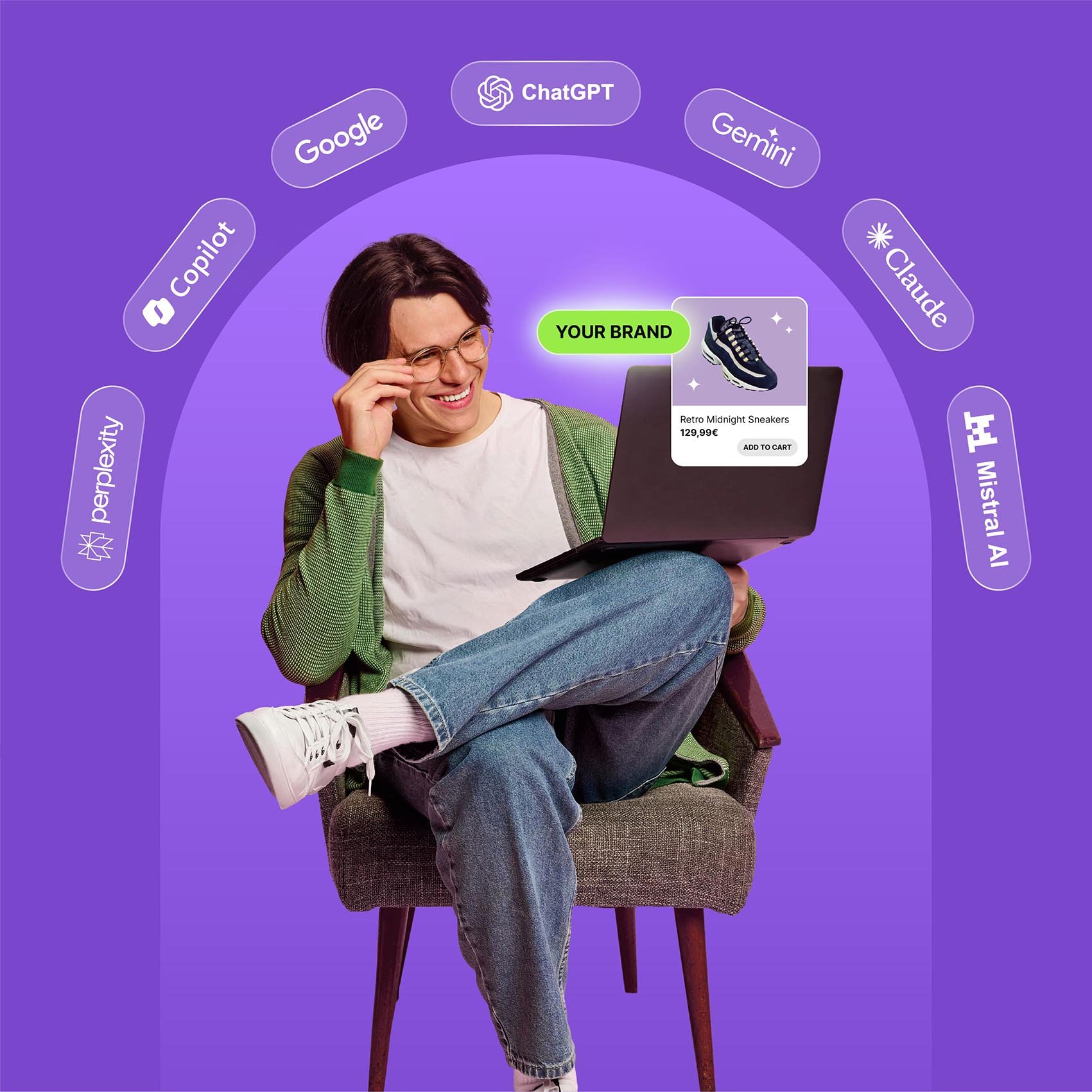
AI is becoming a go-to discovery and transaction channel. Are you ready?
AI agents are now the intermediary between your products and your consumer. This change only promises to grow, with 73% of consumers already using AI for search and 38% for shopping.
It brings up critical questions:
- Are AI agents finding and using my content?
- How do I seize opportunity while staying secure?
- What does visibility mean now?
Join our panel of experts from AWS, DataDome, Retail Economics, and Botify to learn how brands can win in the era of agentic commerce, where AI agents, not just humans, drive discovery, evaluation, and transactions.
Getting agentic commerce-ready means balancing opportunity with security.
As consumers warm up to trusting AI for shopping, agent traffic to websites is surging. E-commerce & retail sites saw a 5.4x spike in agent traffic across 2025, and we’re seeing AI bots crawling at a much higher ratio than Google.
At the same time, 80% of agents don’t properly declare themselves, impacting analytics, security, and accurate decision-making.
In this panel discussion, we’ll cover:

How consumer discovery and transactions are changing in the era of agentic commerce

What you can do to ensure your products are found, seen, and used by AI for agentic commerce

Ways to distinguish good AI from malicious AI, without compromising performance

New metrics to track, making the shift to GEO, and much more
Our Speakers

Richard Lim
Chief Executive
Retail Economics

Jérôme Segura
VP of Threat Research
DataDome

Marco Kormann Rodrigues
Partner Leader, Retail and Consumer Goods (EMEA)
Amazon Web Services

AJ Ghergich
Global VP of AI & Consulting Services
Botify